ai-cur Sign up
Product

Every question it answers, with the screen that shows it.

Twenty-one questions engineers, leads, finance and admins bring to their AI spend, each with the screen that answers it, who can see it, and which plan holds it.

Spend

One page for every vendor you pay.

Free

What did we spend, and on what?

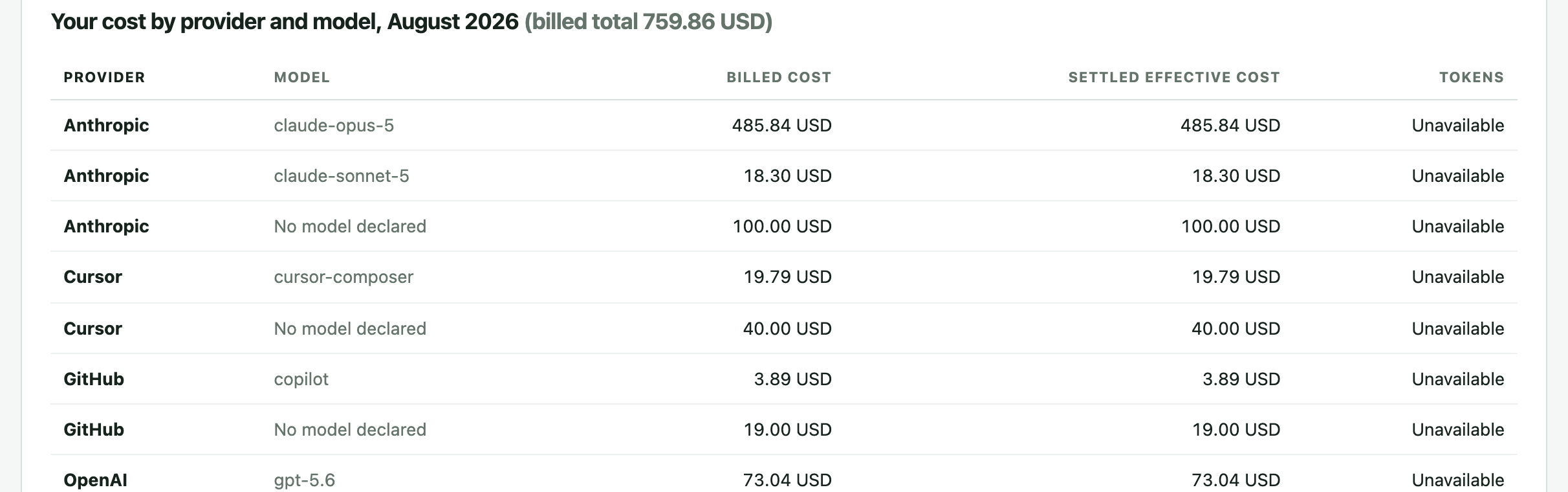
Cost by provider and model for you, for your team and for the company, month by month and by project, with billed and settled figures side by side.

Each person sees their own spend, a team lead sees the team, and leadership sees teams as totals.

One engineer's cost by provider and model for August 2026 in the ai-cur demo: Anthropic, Cursor, GitHub and OpenAI models with billed and settled cost
An engineer's own August, by provider and model.

Why seats times list price stopped working

The same vendor now sells you a seat and then bills usage on top: credits, on-demand requests, overage charged after the month closes. A headcount times a seat price leaves out whatever that usage came to.

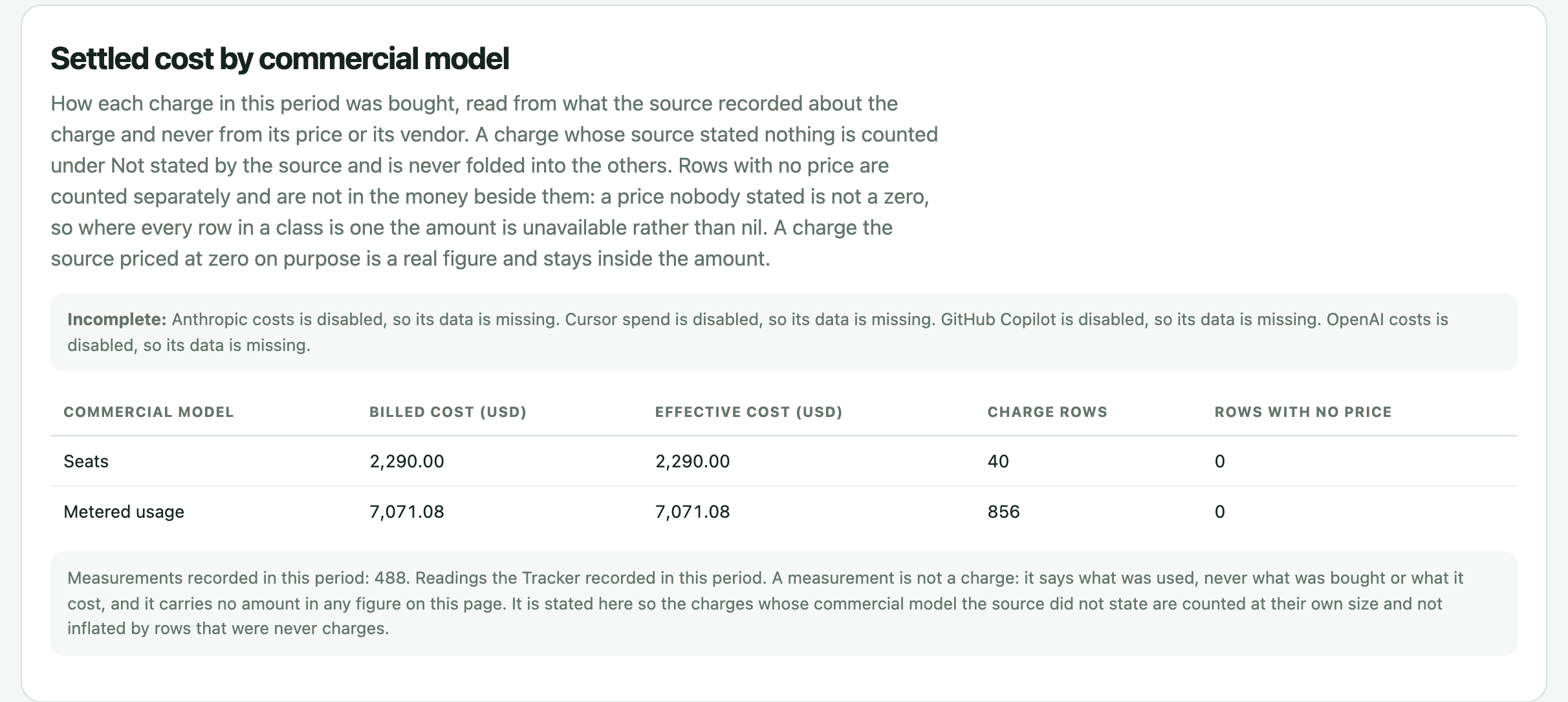
ai-cur files every charge under how it was bought, as the source recorded it, and keeps seats and usage apart all the way to the total.

Settled cost by commercial model in the ai-cur demo finance view: seats, metered usage and charges the source did not classify, each with billed and effective cost and rows with no price counted separately
One month of charges, filed by how each one was bought.

Your vendors' dashboards are good. Each shows one vendor.

Anthropic, Cursor and GitHub each include usage reporting with the plan you already pay for, and it keeps improving. What a vendor's own dashboard is not built to show you is its competitors on the same page, in one currency, against the same people and the same merged work. That page is the product.

VendorCost per personWhat the cost figure is
Anthropic, Claude CodeYesEstimates, labelled as such; the billing page is the authority1
OpenAINot by personBilled amounts, grouped by project, line item or API key2
CursorYesSpend per user, through the Admin API3
GitHub CopilotNo cost fieldUsage metrics that carry no cost, in the API schema we read4

Four vendors, four different cost models: two of the four report cost per person, and no two report it the same way. From each vendor's own documentation, read on 8 August 2026.

Seats

Seats that earn their place, and the ones that don't.

Team

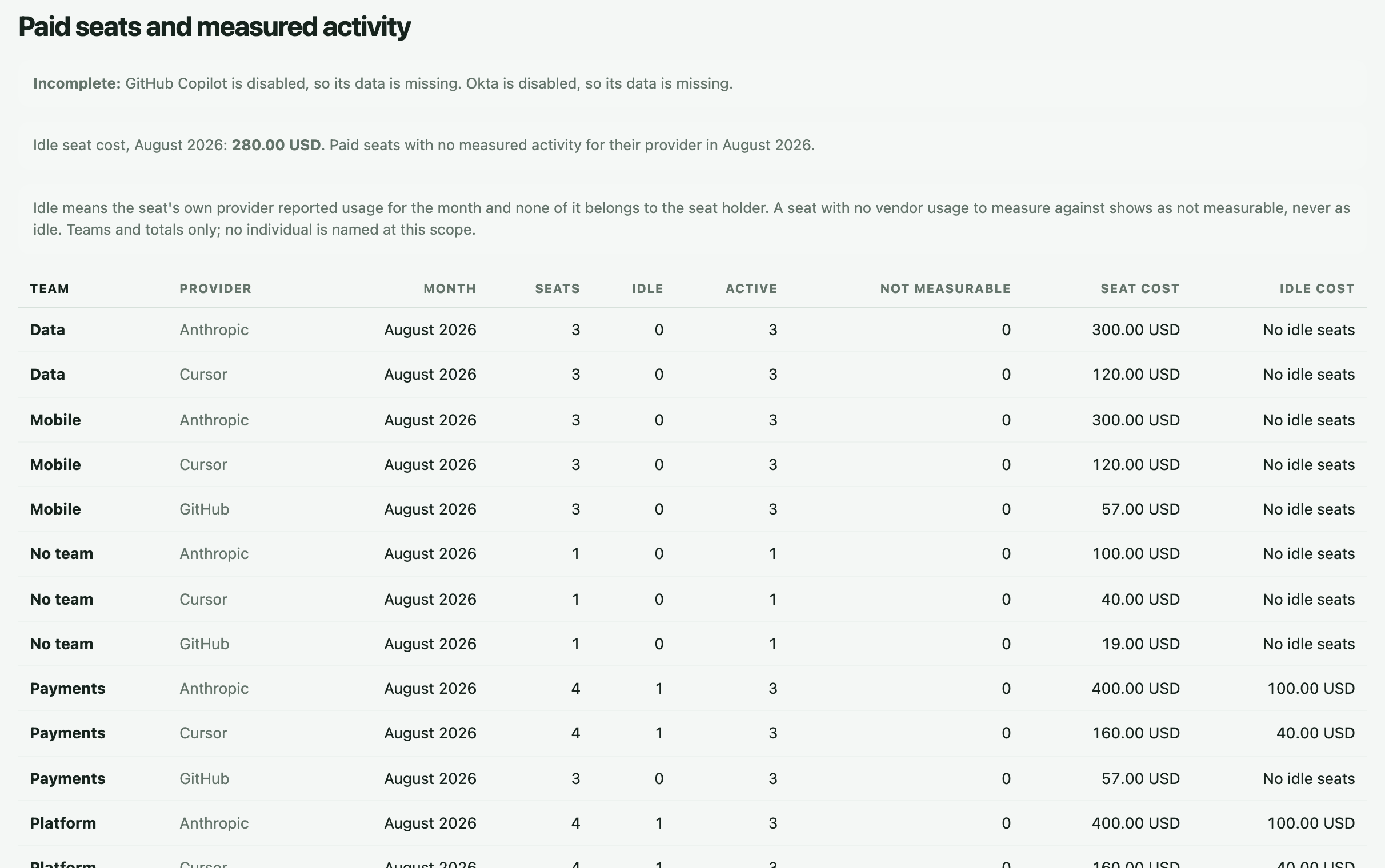
Which seats sit idle, and what do they cost?

Each paid seat is classed as active, idle, not attributable or not measurable for the month, and the classes add up to the whole seat bill. Idle means the vendor reported usage that month and none of it was the seat holder's.

In the demo, August's idle seats cost 280.00 USD.

Paid seats and measured activity in the ai-cur demo: seats per team and provider with idle, active and not measurable counts, seat cost and idle cost for August 2026
Seats per team and provider, idle ones costed, nobody named.
Team

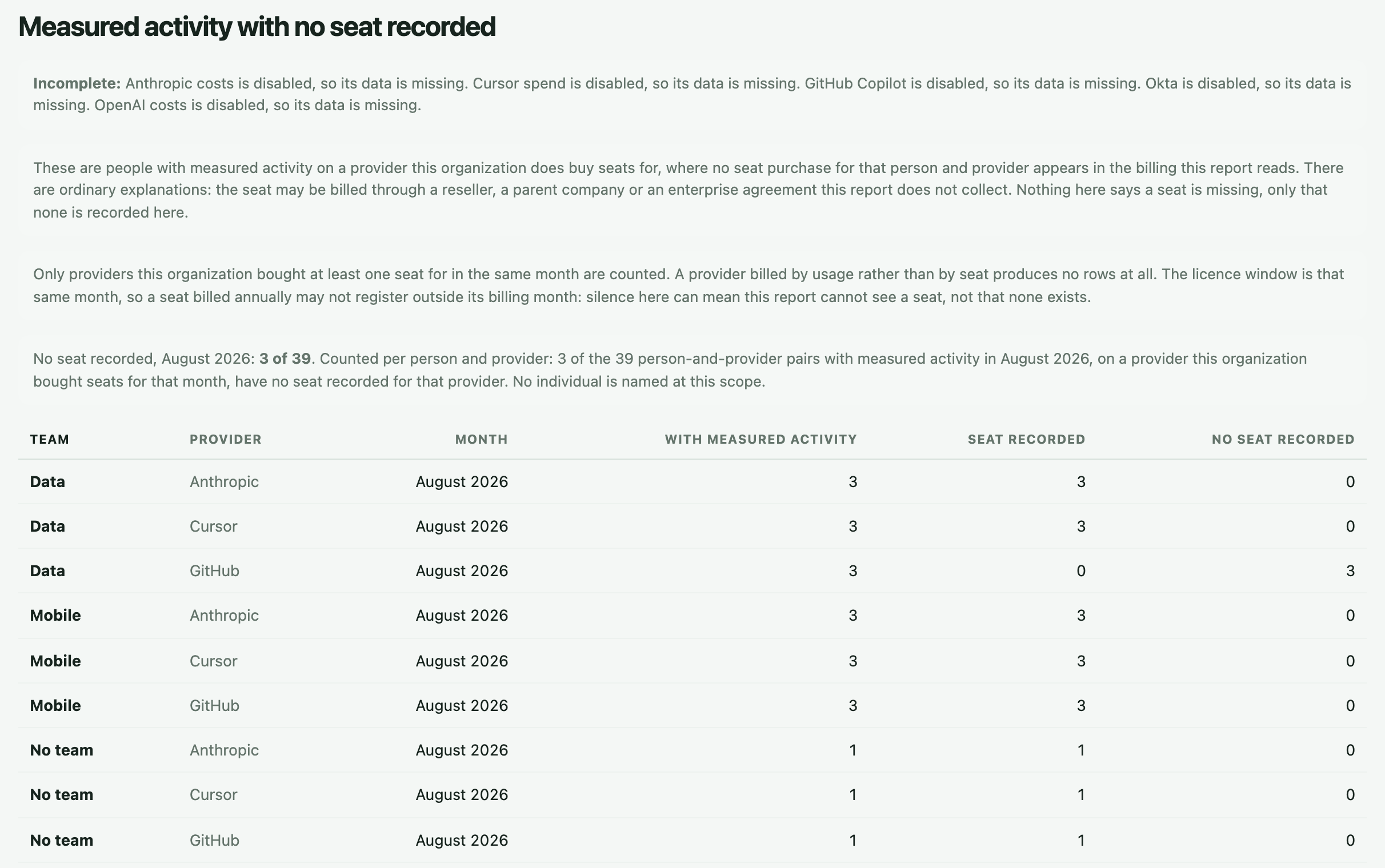
Who uses a tool with no seat on record?

Copilot, Cursor or Claude used by people with measured activity, on a vendor you do buy seats for, where the billing ai-cur reads holds no seat for them.

That seat may sit on a reseller's invoice or a parent company's agreement, so the page says no seat is recorded here, and never that one is missing.

Measured activity with no seat recorded in the ai-cur demo, with the page's explanation that a seat may be billed through a reseller, a parent company or an enterprise agreement
The explanation is on the page, above the rows.
Team

Would this person cost less on usage than on a seat?

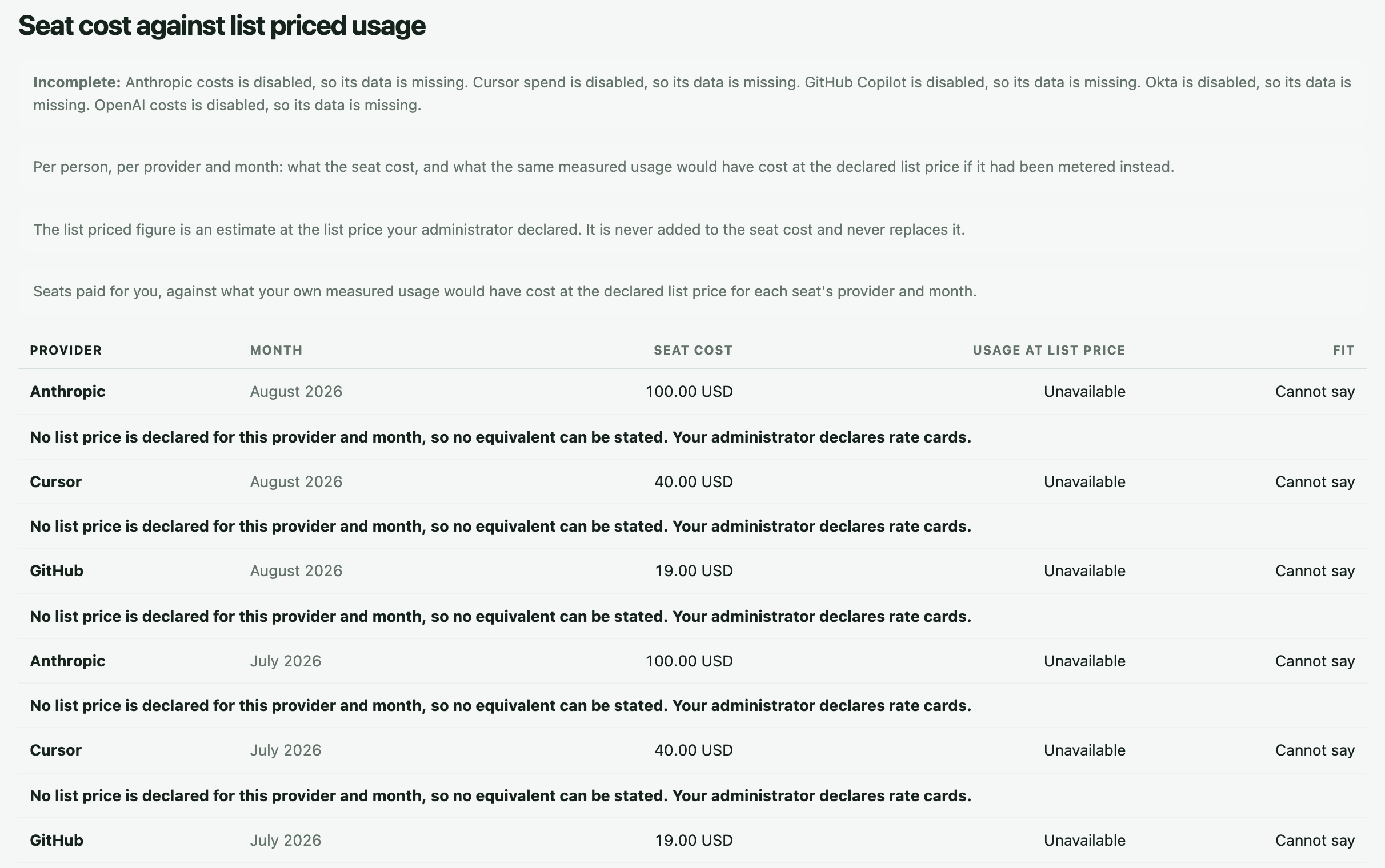
Plan fit sets each seat's price against what the same measured usage would cost at list prices. The list figure is an estimate that sits beside the seat cost and is never added to it.

No usage record carries a list price by itself, so until your admin declares a rate card the answer reads Cannot say.

Seat cost against list priced usage in the ai-cur demo: each seat's cost beside usage at list price, with Fit reading Cannot say because no list price is declared
With no rate card declared the answer reads Cannot say, never a guess.
Work

Spend beside what shipped.

Free for your own, Team for teams

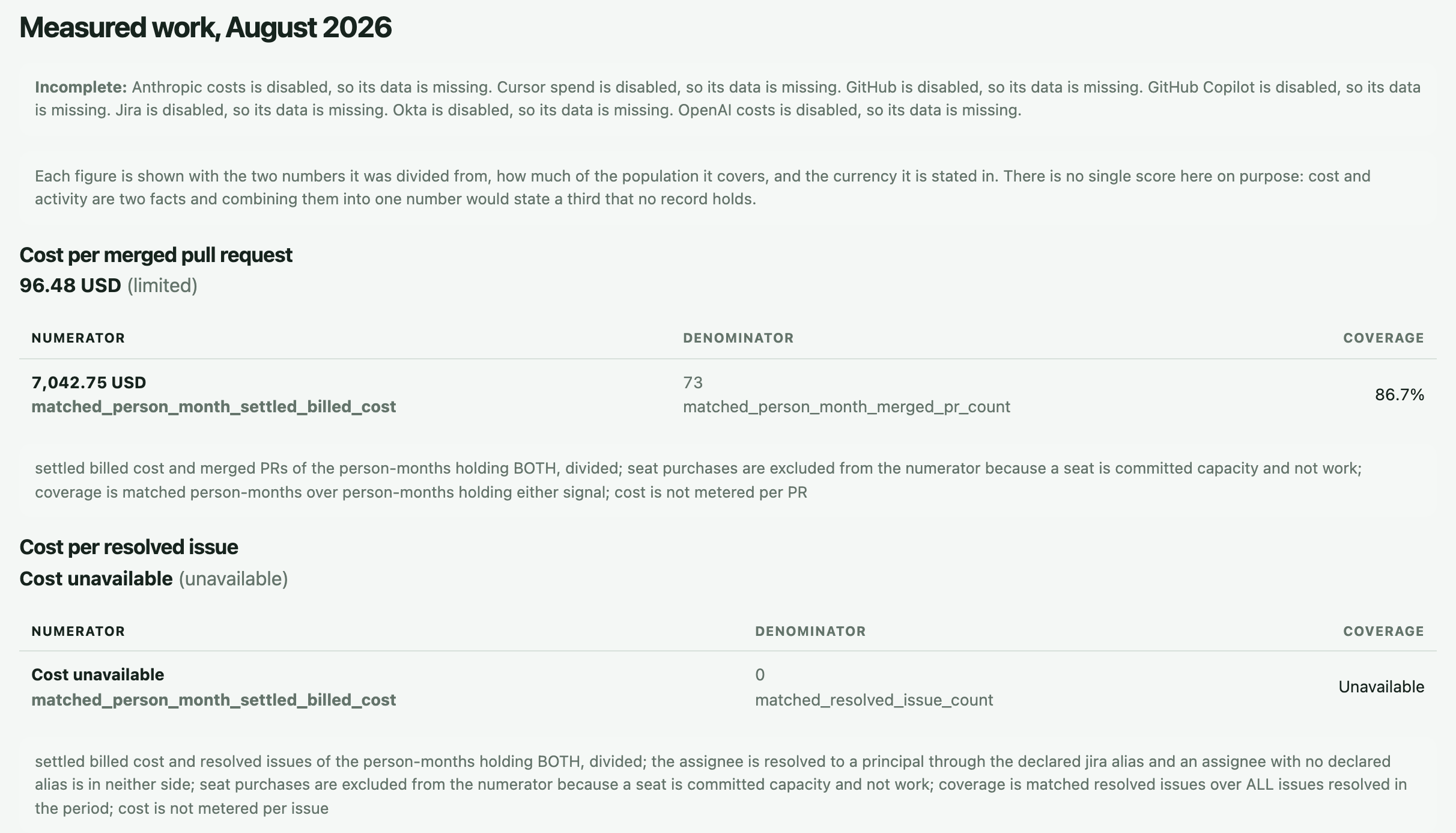
What does a merged pull request cost?

Cost per merged pull request, per resolved issue and per epic, each printed with the cost and the count it was divided from and the share of people it covers. Seat purchases stay out of the cost, because a seat is capacity, not work.

Team figures wait for a minimum cohort, so a very small team never has one person's month published as its own.

Measured work for August 2026 in the ai-cur demo: cost per merged pull request with its numerator, denominator and coverage, and cost per resolved issue shown as unavailable
Each figure keeps its numerator and denominator in view.
Team

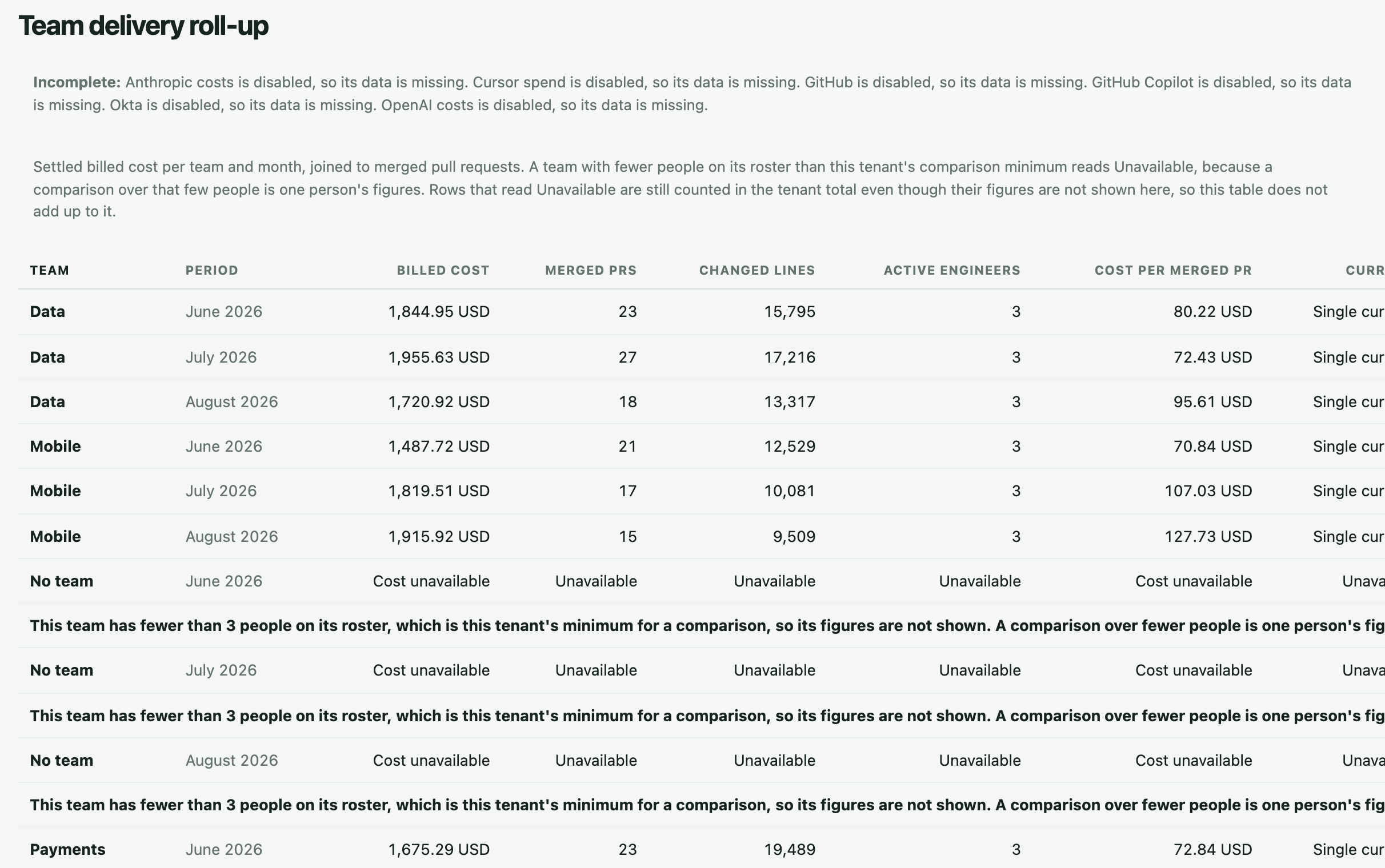
How does my team compare with the others?

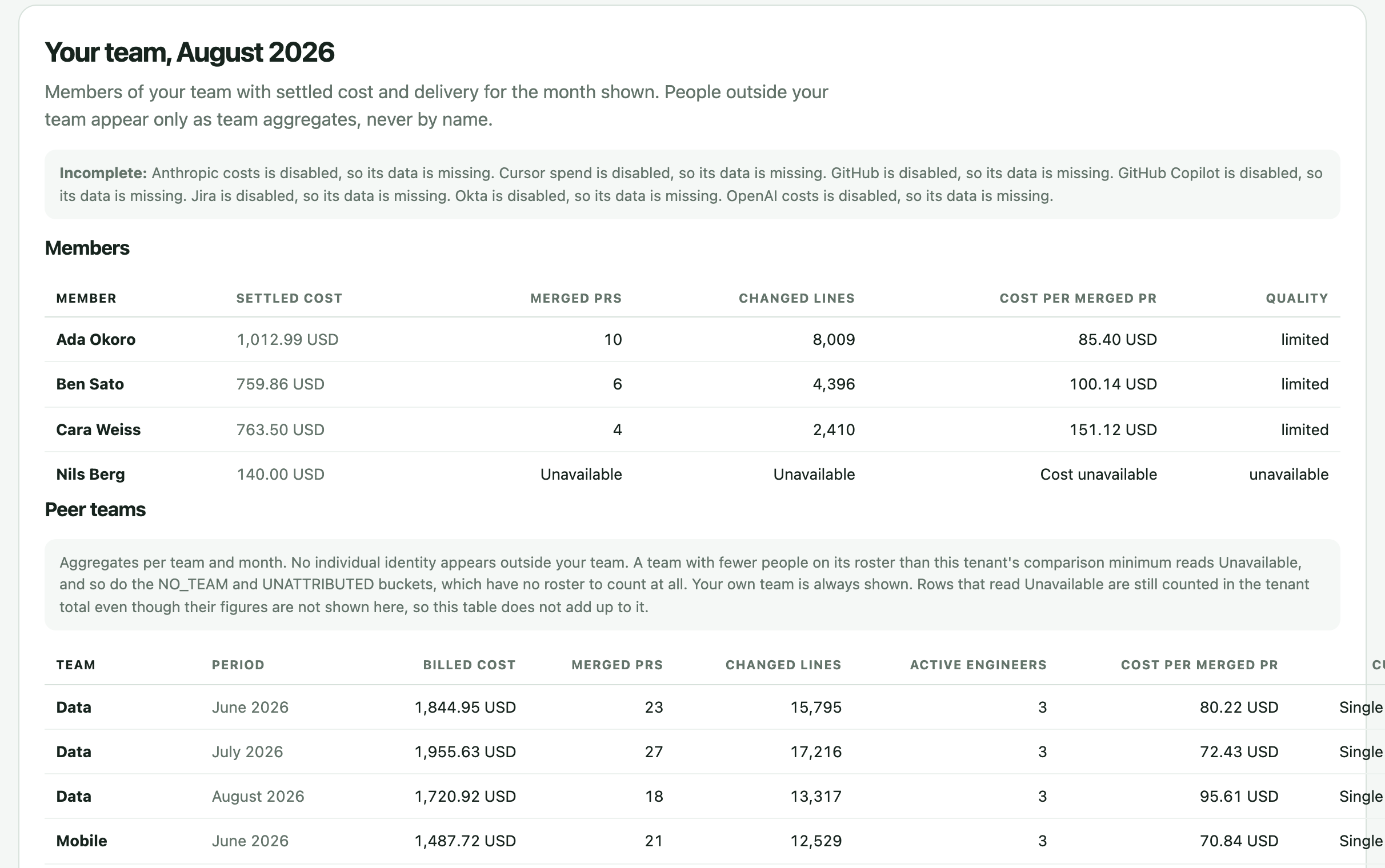
A lead sees their own team in full and peer teams only as totals, with nobody outside their team named.

A comparison appears only when a team's roster meets the minimum your admin declares. Below it the row reads Unavailable, and its cost still counts in the company total.

Team delivery roll-up in the ai-cur demo: settled billed cost per team and month joined to merged pull requests, with rows under the comparison minimum reading Unavailable
Every team side by side, once each is big enough to compare.
Team

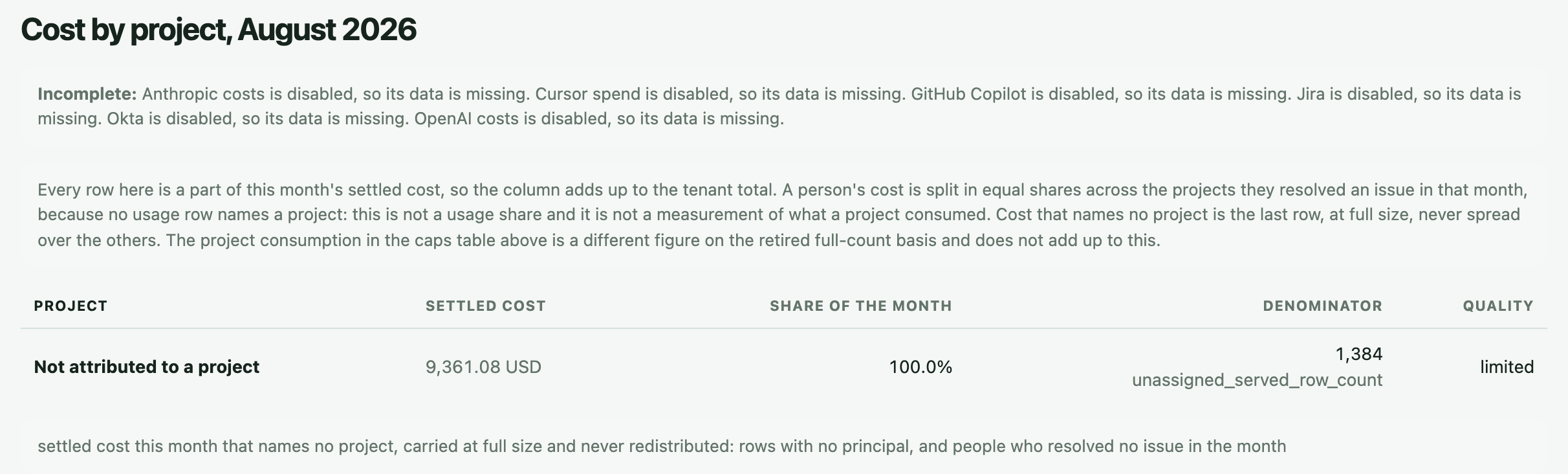
Which projects is the money going to?

Settled cost is split across the projects each person resolved Jira issues in that month, and the column adds up to the company total.

No usage record names a project, so the split follows work references and is stated as a share, never as what a project consumed. Cost with no project gets its own row, at full size.

Cost by project for August 2026 in the ai-cur demo, with the page's note that a person's cost is split in equal shares across the projects they resolved an issue in
A lead's project split, with the rule it follows written above it.
Budgets and caps

Limits your gateway can read.

Team

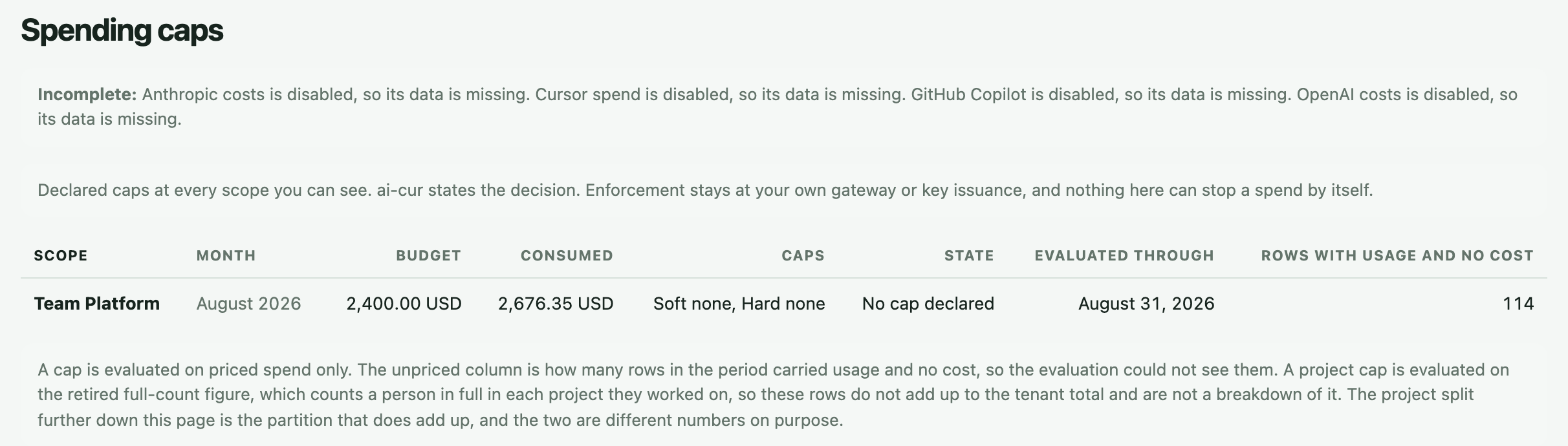
Can a team be stopped before it overspends?

Declare a monthly budget for a team, a project or a person, with alert thresholds and soft and hard caps. ai-cur works out the cap state and serves it as a decision your own gateway or key issuer can act on.

It ships the decision, not a gateway, so nothing here blocks a request by itself.

Spending caps in the ai-cur demo: Platform's August budget and consumption with soft and hard caps reading No cap declared, and the note that enforcement stays at your own gateway or key issuance
The cap panel states the decision and who enforces it.
The money record

Figures finance can post.

Team

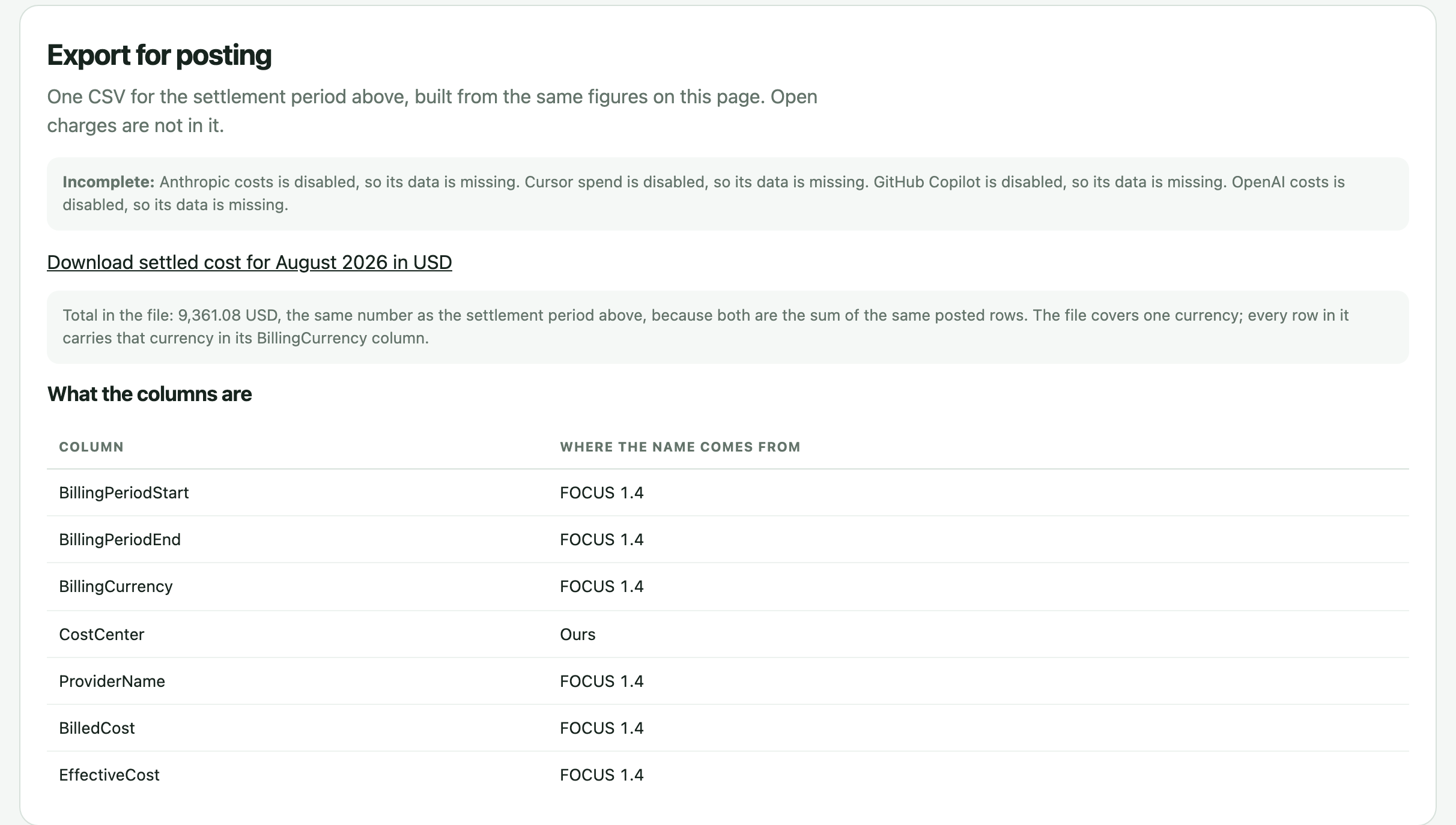
What do we post for the month?

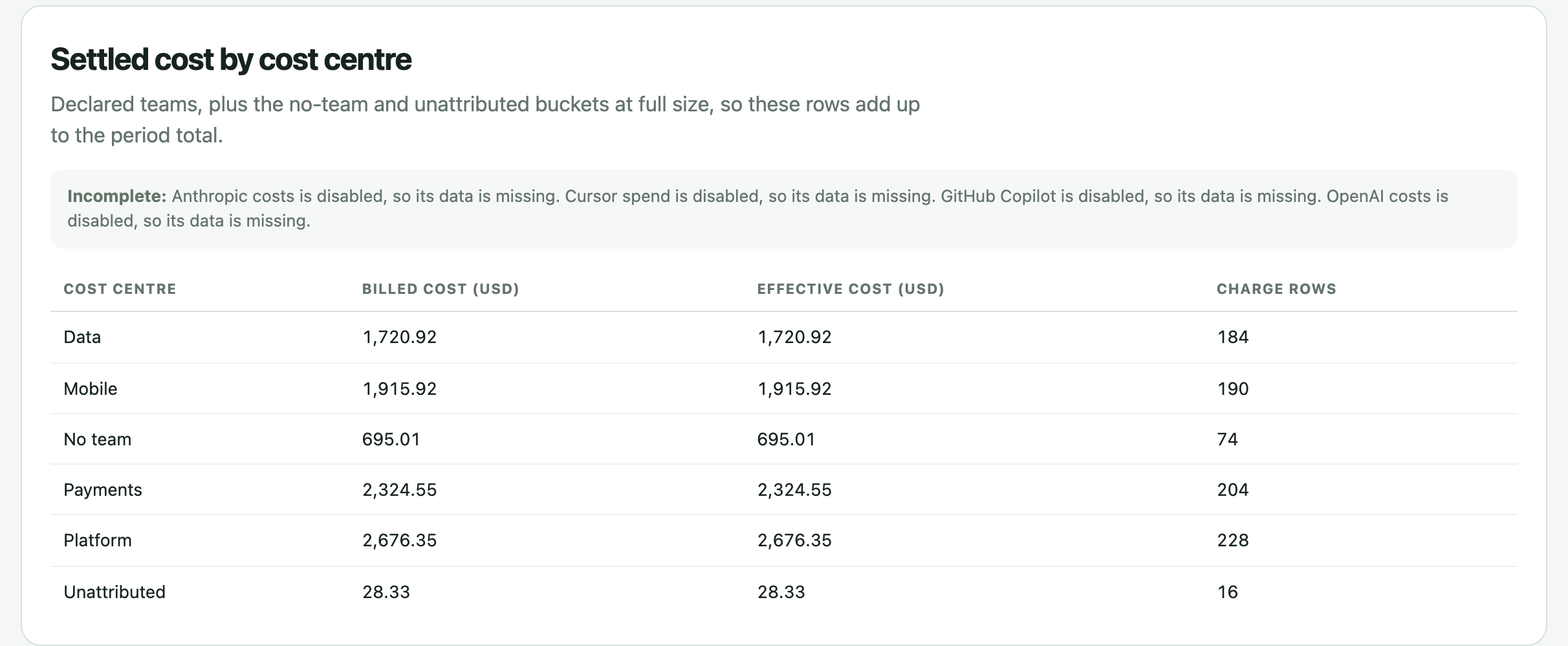
The finance view closes a month by cost centre, provider and commercial model, and holds open charges back until the vendor settles them. No individual is named anywhere in it.

The chargeback export is one CSV per month and currency, built from the same settled rows, so the file's total is the page's total.

Export for posting in the ai-cur demo finance view: a download for settled cost for August 2026 in USD, total in the file 9,361.08 USD, and the columns the file carries
The export and what each column is.
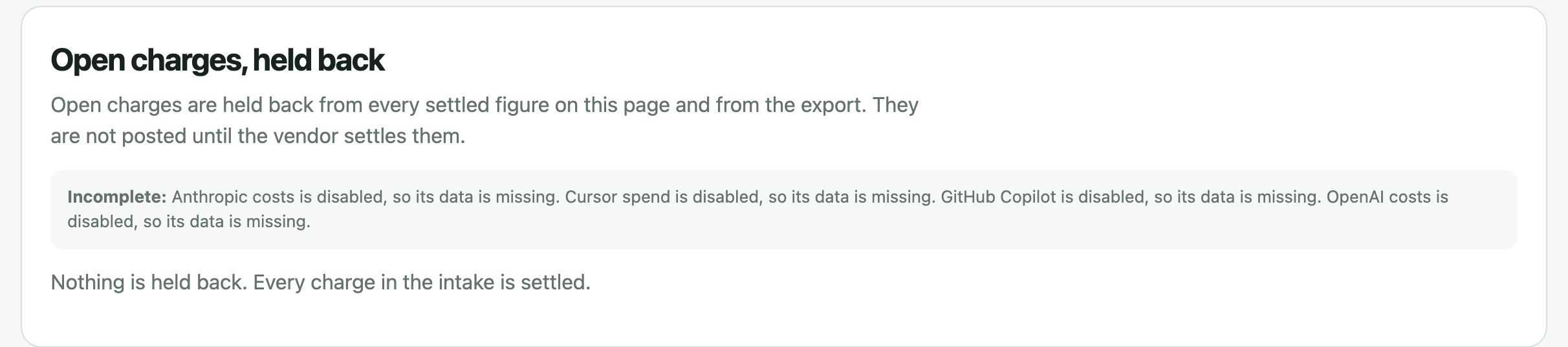
Open charges, held back, in the ai-cur demo finance view: nothing is held back because every charge in the intake is settled
Open charges are named, and kept out of every total.
Business

What did we commit to, and at what rate was it bought?

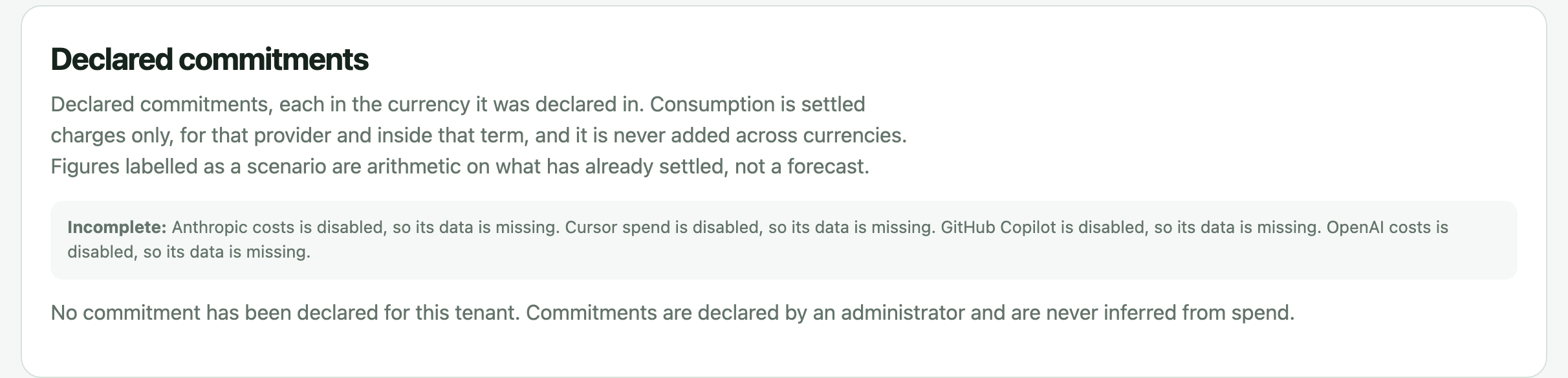
Declare the commitments in the contracts you hold, and ai-cur tracks each drawdown from settled charges only, in the currency it was declared in.

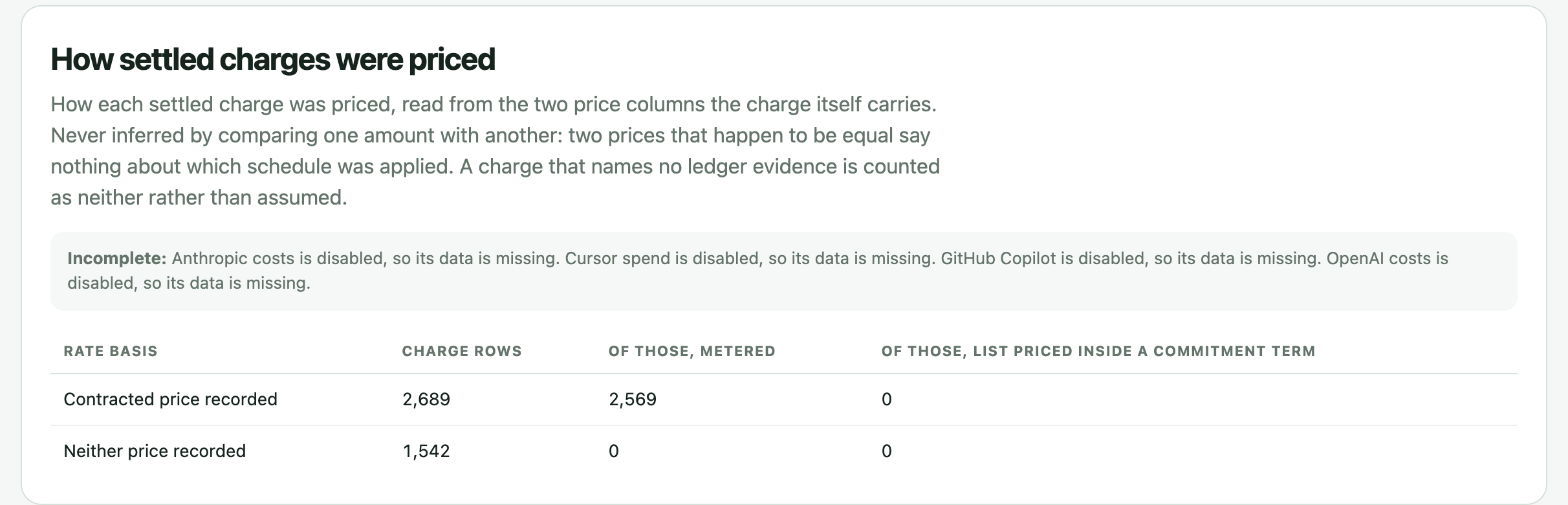
Each charge is marked by its rate basis: a contracted price recorded, a list price, or neither, which stays unknown instead of being guessed.

How settled charges were priced in the ai-cur demo: charge rows with a contracted price recorded and rows with neither price recorded
The rate basis of every settled charge.
Declared commitments in the ai-cur demo: no commitment has been declared, and commitments are declared by an administrator and never inferred from spend
Commitments and their drawdown, empty until you declare one.
Every plan

Is any total mixing currencies?

Every amount carries its currency, and no total anywhere adds two together. Where a group holds more than one currency, its total is withheld and the page names the currencies it found.

A metric takes the currency of its cost. Nothing is converted, defaulted or assumed.

The ai-cur demo finance page header: settled cost by cost centre and by provider for one billing period, source access per integration, and the statement that every figure on the page is in USD
The finance page states its currency before any figure.
Every plan

Is that zero real, or is a source down?

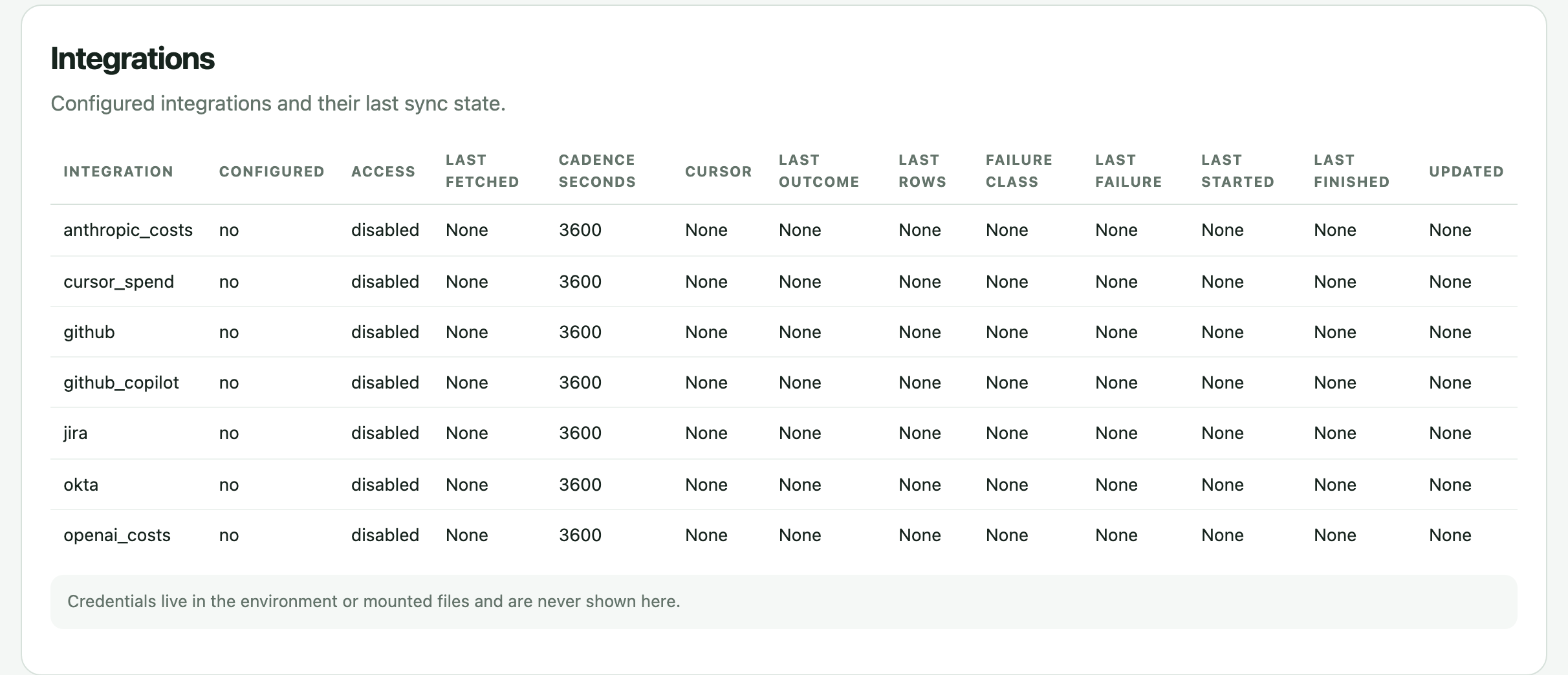
Each source carries an access state: never attempted, disabled, denied, failed, stale, live or unscheduled. A page names its incomplete sources right above the figures they touch, so a missing feed never passes as a silent zero.

Integrations in the ai-cur demo admin page: each integration with whether it is configured, its access state, last fetch, cadence and last failure
The admin's list of sources and their state.
Every plan

What happens when a vendor corrects a charge?

A correction is a new row that names the charge it supersedes. The original is never edited or deleted and stays visible, and a restated figure carries a restatement mark on the page.

Every served figure keeps its lineage back to the raw charge it came from.
Free

How close am I to my plan's limit?

Quota and credits are the free Tracker's job, on your own Mac: it reads your Claude, Codex and Cursor subscription gauges, shows paid credit state, and warns before a limit runs out.

The hosted product does not track provider credit balances.

Teams, access and your account

From one laptop to a whole team.

Free

When does a team view appear?

As teammates install. Every install gets a token of its own, tied to the person who runs it, and once people are mapped to a team the lead's view fills in, member by member.

People without a team and installs without a person are listed too, so nobody's cost drops out of the totals.

Team view for the Platform team in the ai-cur demo: each member with settled cost, merged pull requests, changed lines and cost per merged pull request for August 2026
Platform's lead, with every member who has installed.
Free

Who sees what, and how does one person become a team?

Invite teammates by email and a personal account turns into a team; becoming a team keeps everything the person already had. Members hold member, admin or owner roles, with a single owner.

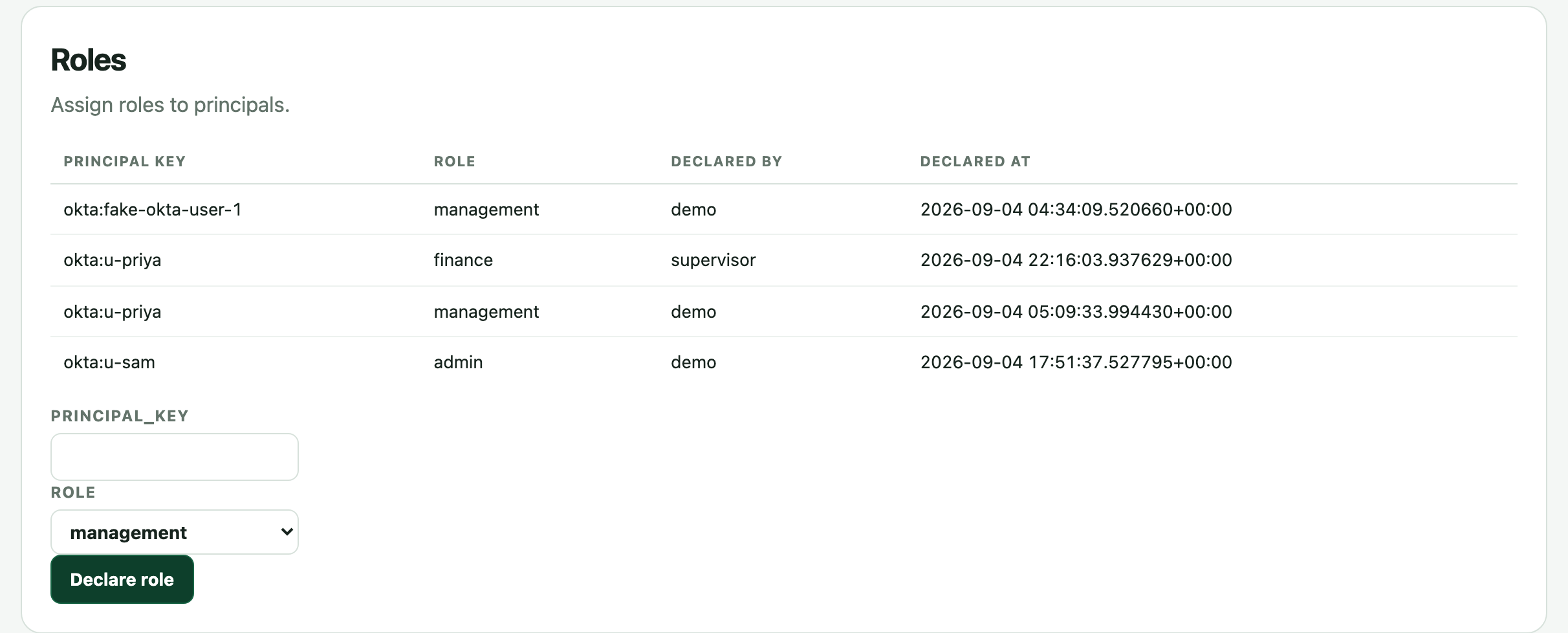
Inside the report, admins declare management, admin and finance roles, and the database decides which rows each role can read.

Roles in the ai-cur demo admin page: principals with the management, finance or admin role, who declared each and when
Roles are declared, and each declaration keeps its author.
Team and Business

How do people sign in?

Teams sign in with a magic link by email, or with Google or Microsoft. Business customers sign in through their own identity provider, such as Okta, and team membership comes from the Okta groups an admin maps, never from who happened to sign in.

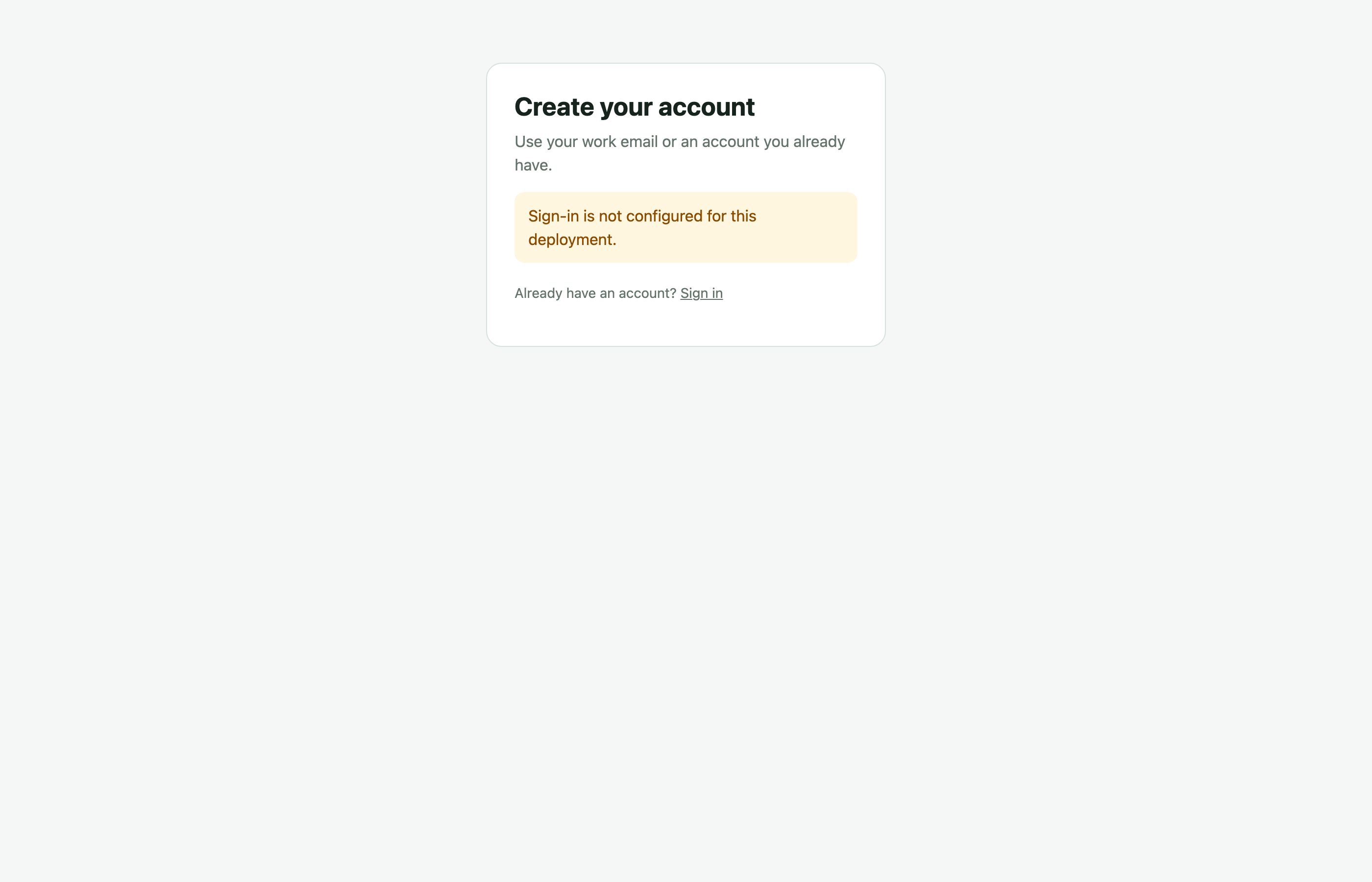
Sign up and Sign in are the two doors in the header. The same page sends a link by email or continues with Google or Microsoft; there is no password to keep.

The ai-cur sign-up page on the demo host, reading Create your account, with the notice that sign-in is not configured for this deployment
The sign-up page: a link by email, or Google or Microsoft once they are switched on.
Team

Can we try Team first?

Yes. A team runs a Team trial with no card, and when the trial ends without one it simply ends; nothing is charged. There is one trial per team.

The trial starts from your team's billing page after sign-up, through Stripe checkout, and the same portal is where a card is added or the plan is stopped. The steps are on the trial page.

Every plan

Can I take my data out, or delete it?

Download an export of what is held about you whenever you like. Deleting your account starts a governed deletion: a link by email lets you cancel it for a short while, and the purge itself waits out a grace period before anything is erased.

Every plan

How does the Tracker know what my plan includes?

The hosted service signs an entitlements document for your account, and the Tracker checks that signature against a public key set anyone can fetch. A feature your plan does not include stays locked, and an unknown feature unlocks nothing.

Off by default

Can the Tracker send its work report to the hosted view?

The hosted service has an intake for the Tracker's work report, the per-project and per-task summary it builds on your own machine. The intake stays off until an operator turns it on.

The free Tracker

Start free, on your own machine.

The AI Usage Tracker is a free, open-source menu bar app for macOS. It needs no account, and it is where anyone can start before a team exists.

What it reads

Claude Code and Codex sessions in the files they already write on your Mac, every minute, and, if you choose, your Claude, Codex and Cursor subscription gauges.

What it shows

Usage trends, paid credit state, and alerts on quota thresholds, projected exhaustion and stale credentials. An API-only mode skips the subscription gauges.

Your work, on your machine

A local work ledger assigns sessions to projects and tasks, with a review window to correct them and daily or weekly reports. A ratio it cannot divide honestly is left blank, not zero.

Nothing leaves by default

The activity timeline is a contentless index: session text stays in the files it came from.

The source, on github.com/harvto-llc/ai-usage-tracker

Standards

A cost record other tools can read.

Every cost record ai-cur keeps is shaped after FOCUS, the open billing data specification, and the finance export names its columns in FOCUS terms6. That makes it FOCUS-aligned. No validator has tested it, so it is not a certification.

The record already keeps the model and the input and output tokens separately wherever the vendor reports them, which is where the specification's next version is scoped to go.

Platforms will keep adding cost controls.

Gartner's 2026 evaluation of AI coding agent vendors counts cost controls and usage analytics among the capabilities it expects5. Expect every vendor's own reporting to keep getting better.

That helps you, and it leaves the shape of the problem where it was: each vendor improves the view of its own tools, while your bill, your people and your merged work span all of them.

  1. 1Anthropic, Claude Code analytics, code.claude.com/docs/en/analytics, read 8 August 2026.
  2. 2OpenAI, Costs endpoint reference, developers.openai.com, read 8 August 2026.
  3. 3Cursor, Admin API, cursor.com/docs/account/teams/admin-api, read 8 August 2026.
  4. 4GitHub, Copilot usage metrics API, docs.github.com, read 8 August 2026.
  5. 5Virtualization Review, coverage of Gartner's 2026 report on AI coding agents, virtualizationreview.com, 5 June 2026, read 8 August 2026.
  6. 6FinOps Foundation, FOCUS specification, focus.finops.org, read 9 August 2026.

Try each of these on your own month.

Sign up, install the Tracker, invite the team. Team runs for sixty days with no card, and ends on its own if you never add one.