ai-cur Sign up
Deployment

Run it where your data already lives.

One engine and four ways to run it. The profile changes the wording on the page, never who can see what or which figures appear. Below each one: what we have checked on a running system, and what is written down but not yet proved.

Four profiles

Pick the one your security team will sign.

Standalone, on your own servers

The full backend, its Postgres database and the browser app, as one self-hosted deployable you run with docker compose inside your own network. Engineers, leads and management sign in to it with your Okta.

Checked on a running system: it is the build we run ourselves. On 14 September 2026 a fresh deploy was verified live: health check answering, migrations applied at start-up, every served figure identical to the capture taken before it, and a delete against the charge ledger refused.

Public cloud SaaS, hosted by us

The same artifacts as standalone, operated by ai-cur in a public cloud, for teams who would rather not run a database.

Checked on a running system: this is where Sign up takes you. It is the standalone build under our operation, redeployed on 18 September 2026 with the same checks: health answering and every served figure identical before and after. Not yet offered: an uptime commitment in writing.

Databricks App

ai-cur as a Databricks App that reads one managed Delta snapshot of the cost record, with Unity Catalog owning row-level access. It shares the cost record's column mapping with the standalone engine.

Written down, not yet proved live: today this is a compatibility map over the current source definitions, and its live workspace check failed when the map was written.

By Databricks' documentation, Unity AI Gateway budgets leave out two kinds of spend: provisioned throughput, and inference on models hosted outside Databricks1. ai-cur reads Anthropic and OpenAI billing directly, so spend routed around those budgets still lands in the same record.

ServiceNow scoped app

A scoped app inside your ServiceNow instance: the FOCUS-shaped AI cost record, billing export ingestion, Tracker push, reconciliation to the invoice, and persona views under role-based access.

Written down, not yet re-audited: its parity with the standalone engine has not been checked against the current code.

ServiceNow buyers already feel the problem it addresses: coverage of AI Control Tower reported that assist counts vary from one agent interaction to the next, so usage, and the bill with it, is hard to predict2. The scoped app sits beside Control Tower's governance and adds unit costs in money.

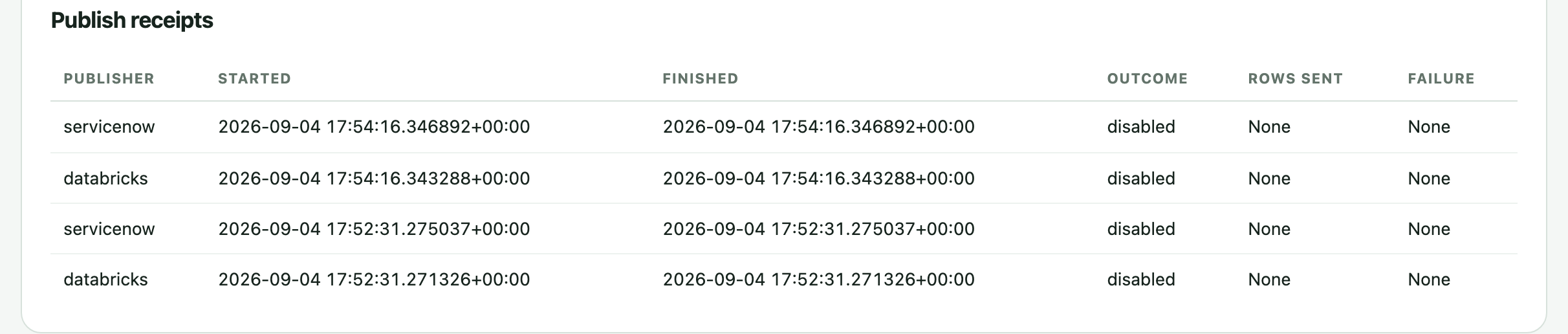
Publish receipts in the ai-cur demo admin page: the Databricks and ServiceNow publishers, each run recorded with the outcome disabled
Every publish to Databricks and ServiceNow is recorded with its outcome, and a publisher that is switched off says so.
What the code enforces

Rules held in the database, not in a promise.

Each of these is enforced by the schema or the service itself, in every profile. The report says the short version to every reader.

The What this report protects panel in the ai-cur demo: signed-in identity from your identity provider, authorization in the database, aggregates without personal identifiers for wider scopes, and missing evidence shown as unavailable
What an engineer's report says it protects, at the foot of the page.

An append-only ledger

The charge ledger only grows: a row trigger refuses updates and deletes, and a statement trigger guards against TRUNCATE, the one bypass a row trigger cannot see. Both were confirmed enabled on our running host.

Views that fail closed

Every served view filters on the tenant context inside the database, so a request with no tenant context set gets zero rows by construction. Admin and finance views also need a role the web layer sets only after it finds a declared one.

Your content stays inside the boundary

No prompt, transcript or file content leaves your boundary. From GitHub it takes metadata: pull requests, commit counts, changed lines. The Tracker's activity index is contentless.

A revocable token per install

Each install holds its own token. Only a hash of the secret is stored and the secret is shown once; rotating keeps the old token alive for a short overlap, and revoking ends it at once.

Corrections that never overwrite

A correction is its own row naming the charge it supersedes. A row cannot supersede itself, and an unsettled correction cannot be reached, so nothing is counted twice or quietly erased.

Money always denominated

No currency is defaulted or backfilled. Where a group holds more than one currency, every money aggregate in the product returns no total and names the currencies it found, rather than adding them together.

A minimum cohort before comparison

Team comparisons wait for a minimum cohort. The cohort is the declared roster, not whoever happened to be active, and a comparison that is too small is withheld rather than published.

Source access state on every page

Every source carries its access state, and a page names the incomplete ones above the figures they touch, so a missing feed is never a silent zero.

Signed entitlements

What a plan includes is a signed document, checkable against a public JWKS key set at a well-known address, with the feature manifest pinned by path and digest.

Governed deletion, with grace

Deleting an account is governed: an email link can cancel the request for a short while, and the purge waits out a grace period on a request that has matured.

Standards

FOCUS-aligned, and exactly that.

The cost record is shaped after FOCUS version 1.4, the billing data specification the FinOps Foundation ratified on 4 June 20263, and the finance export names its columns in FOCUS terms.

That is an alignment claim, not a certification, and no FOCUS validator has tested the record. The record already keeps the model and input and output tokens apart wherever a vendor reports them.

  1. 1Databricks, Unity AI Gateway budgets, docs.databricks.com, read 8 August 2026.
  2. 2CIO.com, article on spend visibility in ServiceNow AI Control Tower, cio.com, read 8 August 2026.
  3. 3FinOps Foundation, Introducing FOCUS 1.4, finops.org, read 9 August 2026.

Tell us where it would run.

Standalone, hosted, Databricks or ServiceNow: we will say plainly what is proved for your profile before you commit to anything.